My Little Funhouse from; Active; 1991 – 1996
Style; Rock
Vocals; Alan Lawlor
Guitar; Brendan Morrissey
Guitar; Anthony Morrissey
Bass; Gary Deevy
Drums; Derek Maher replaced in 1993 by Graham Hopkins
Coca Cola S’kool Band contest 1991.
In 1991My Little Fun House made it through to the final of the Coca Cola S’kool contest, and came 3rd . The final was held in McGonagle’s, Dublin. With young bands from all over Ireland playing. The line up was first Jeremiah Jones from Donegal, next were The Tempted from Cork, then Perfect Blue from Cork, followed by Major Haze from Edenderry, they were followed by the winners from Dublin Alewishus Phontains, My Little Fun House from Kilkenny, Grin from Waterford, Savage Fairies from Youghal.
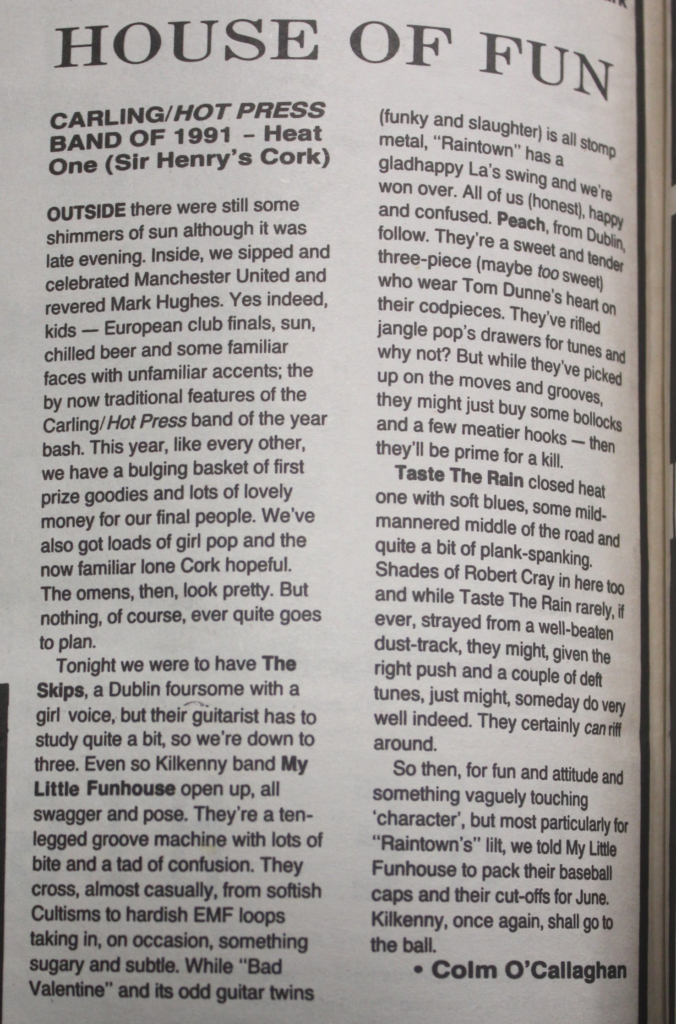
Carling Hot Press Battle Of The Bands 1991
The competition is held at Sir Henry’s, in Cork over 5 weeks. With the winner each week going on to the final.
Heat 1, 15th May Peach (Dublin), Taste The Rain (Wicklow), The Skips (Dublin), My Little Funhouse (Kilkenny).
Winner; My Little Fun House
Heat 2, 22nd May The Dreads (Drogheda), Nest (Galway), Callan (Dublin), Touchstone (Wexford)
Winner: The Dreads
Heat 3, 29th May A Rose For Emily (Mullingar), Daisy Thorns (Dublin), Hungry Judges (Galway), Tennessee Surfers (Dublin)
Winner; Daisy Thorns
Heat 4, 5th June Eccentric Hedgehogs (Cork), Echo India (Dublin), 33rd Hurricane (Donegal), Mississippi Mermaids (Dublin)
Winner; Mississippi Mermaids
Heat 5, 12th June Christina Calls (Dublin), Just In Time (Dublin), The Muldoons (Tyrone), ??????????? (Dublin)
Winner; The Muldoons
Final 6th June My Little Funhouse, The Dreads, Daisy Thorns, Mississippi Mermaids, The Muldoons
The Winners My Little Fun House
The Judges, George Byrne (Irish Independent), Richie Taylor (Sunday Press) Jackie Hayden (Hot Press), Niall Stokes (Hot Press), Emmett O’Reilly (Hot Press)
Formation and early career
My Little Funhouse formed in 1990 in Kilkenny, Ireland, when school friends Alan Lawlor (vocals, aged 15), Gary Deevy (bass, aged 15), Derek Maher (drums, aged 15), and Tony Morrissey (guitar, aged 15) decided to start a band together. Tony’s older brother, Brendan Morrissey (guitar, aged 18), soon joined after playing in other local bands, completing the initial lineup. The group enlisted their friend Michael Lanigan as manager to help organize their early efforts. Rehearsals took place in informal settings such as front rooms and sheds around Kilkenny, where the band focused on writing original songs. Their early performances were limited to local venues in Kilkenny, including the Pumphouse, Cleere’s, and Henderson’s, marking their initial foray into live shows. A breakthrough came in 1991 during the band’s fourth gig overall, when they entered and won the Carling Hot Press competition at Sir Henry’s in Cork, earning a publishing deal with Island Music in London. Following the victory, they recorded demos at Sun Studios in Dublin, which showcased a sound reminiscent of Guns N’ Roses and drew attention from the music industry. Island Music’s A&R representative, Richard Brown, actively promoted the tapes to major labels, generating significant buzz around the young group’s potential. This early momentum ultimately led to a major label signing with Geffen Records later that year.
Signing a publishing deal with Island
The group quickly rose to prominence after winning the Carling Hot Press band competition shortly after forming, which led to a publishing deal with Island Music and widespread attention for their energetic live performances.[2]In late 1991, My Little Funhouse secured a landmark $2 million recording contract with Geffen Records—one of the largest ever for a debut act at the time—championed by A&R executive Tom Zutaut, who had previously discovered Guns N’ Roses.[2] The band, still teenagers for much of their early career, released their debut album Standunder in 1992, produced by Bill Price and recorded live over ten days in London; it featured tracks like “I Want Some of That” and “Raintown,” supported by music videos and extensive touring, including opening for Guns N’ Roses at Slane Castle in front of 45,000 fans
Getting Dropped for Grunge sound
Despite initial promise, the band’s hard rock style was overshadowed by the grunge revolution spearheaded by Nirvana’s Nevermind in 1991, prompting Geffen to shift focus away from acts like My Little Funhouse toward Seattle sounds. They recorded two follow-up albums—Forward Came (featuring contributions from Guns N’ Roses members Slash and Matt Sorum, produced by Mike Clink) and Pulse (produced by Joe Barresi)—but both were shelved amid label changes, including Geffen’s sale to Universal, mounting debts, and mismatched touring opportunities. The group disbanded in 2006, with rights to their unreleased material reverting to the band members; Standunder later became available on streaming platforms like Spotify, while Brendan Morrissey has since pursued careers in technology and hospitality.